
Sofreh Aghd: The Persian Wedding Table, Item by Item
The mirror, sugar cones, bread, eggs, honey, coins, spices and all the small details are not random décor. This is a practical guide to what belongs on a Persian wedding Sofreh, what the pieces mean, what is genuinely traditional, and how modern diaspora couples are reworking the table without losing the point of it.

A Sofreh Aghd is the symbolic spread placed before a couple during the Persian marriage ceremony. Its objects are wishes made visible: light, sweetness, abundance, protection, nourishment, fertility, wisdom and a prosperous life together.
What is a Sofreh Aghd?
Think of the Sofreh as the visual language of the Aghd. The couple sits behind it; the ceremony happens around it; and nearly every object on it carries a wish for the marriage.
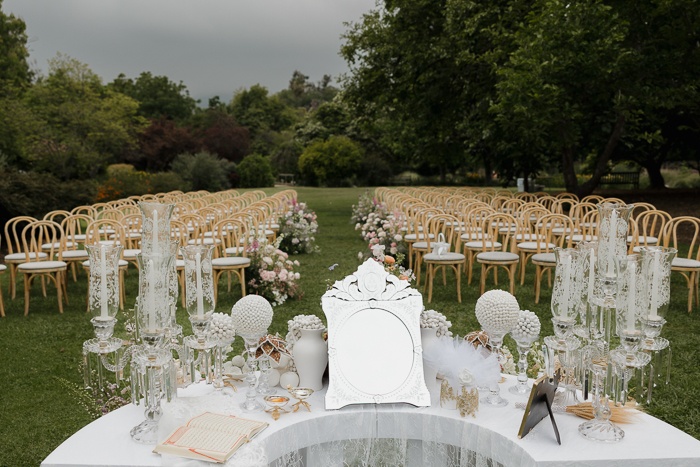
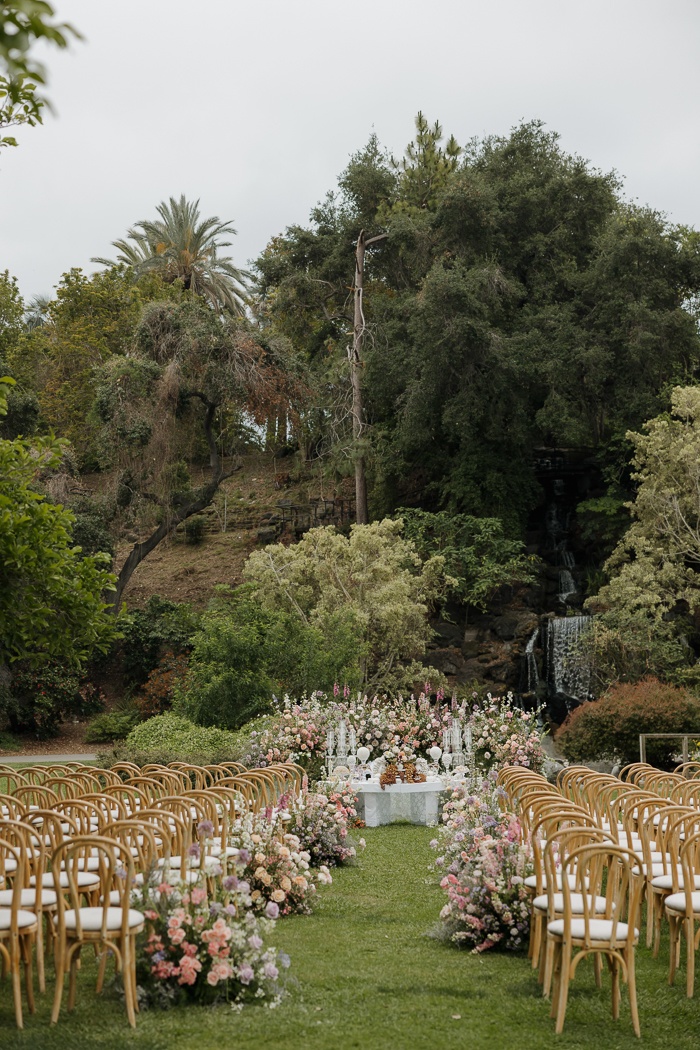
The Sofreh Aghd—also written as Sofreh-ye Aghd, Aghd Sofreh or occasionally Sofra Aghd in English—is the ceremonial Persian wedding spread. Traditionally it was literally a cloth laid out with symbolic objects. Today it may be a low floor spread, a long table, a series of mirrored plinths, a glass platform, a round altar or an architectural installation built around the couple.
What makes it a Sofreh is not whether the surface is rectangular, white, silver, antique or minimalist. It is the collection of culturally recognizable objects and the rituals connected to them: the mirror and candles, sweets, food and fertility symbols, protection pieces, the sugar cones used over the couple, and the honey shared at the end.
The distinction that matters: the Aghd is the Persian wedding ceremony. The Sofreh Aghd is the ceremonial spread in front of the couple. They are closely connected, but they are not interchangeable terms.
For Persian families outside Iran, the Sofreh often does another job too: it explains the culture without requiring a lecture. A guest may not know the Farsi names, but they can see food, light, flowers, poetry, family objects and the sugar ritual and understand that the table is speaking about the kind of life the couple hopes to build.
What “Sofreh-ye Aghd” actually means
Sofreh is an everyday Persian word with a much broader life than weddings. At its most basic, it refers to a cloth or spread used for arranging food; in modern usage it can also mean a tablecloth or the setting itself. Iranian culture has many ceremonial Sofrehs, including the Haft-Sin at Nowruz.
Aghd refers to the marriage contract or marriage-contract ceremony. Put together, Sofreh-ye Aghd means the spread of the Aghd—the ceremonial setting used for the marriage.
Calling it a “Persian wedding table” is useful shorthand in English, especially for guests, but it can hide the original idea. Historically the Sofreh did not need legs. The spread itself mattered. That is why a floor-level cloth with carefully arranged objects and a modern raised acrylic installation can both be recognizably Persian.
The Sofreh is not one decorative object. It is a composition of small wishes for married life.
The history is old. The exact table is not frozen in time.
If you search long enough, you will find claims that every Sofreh Aghd object has been arranged in exactly the same way for thousands of years. That is too neat to be true.
The broader Iranian custom of ceremonial Sofrehs is long established, and historical descriptions of the Aghd specifically record a sofreh-ye aghd covered with symbolic objects. Scholarly accounts describe the mirror, candlesticks, bread, walnuts, eggs, sugar cones, esfand and other pieces, while also noting that regional customs differed.
That regional variation is important. A family from Shiraz could have practices that another family did not. Some older symbolic explanations reflect the social world of their time and are not meanings a modern couple would choose today. Other items—especially the mirror, candles, bread, sweetness, nuts, eggs and sugar cones—have remained highly recognizable across generations.
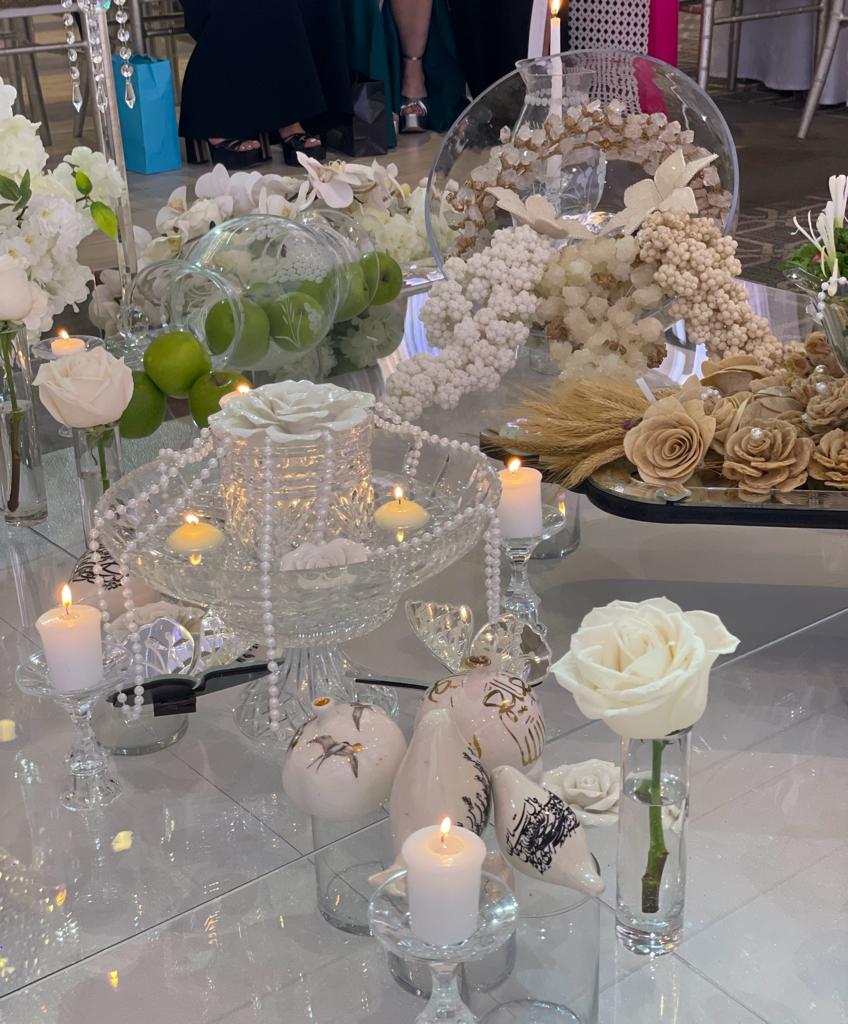
The physical presentation has changed even more. A traditional Sofreh could be a fine embroidered cloth laid low to the ground. A modern Iranian wedding Sofreh in Los Angeles or Toronto might be built on acrylic risers with sculptural florals and dozens of candles. The cultural continuity comes from the objects, their use and the family’s understanding of them—not from copying one historical photograph.
A useful way to think about “traditional”: preserve the rituals and the objects your family understands as meaningful. Let the styling belong to your wedding. Persian culture has never required every Sofreh to be visually identical.
Sofreh Aghd items: a complete guide to what is on the Persian wedding table
There is no single official checklist stamped by a cultural authority. Families add, omit and reinterpret pieces. But the items below are the ones you are most likely to encounter on a traditional or modern Sofreh Aghd.
| Item | What it is / how it is used | Common meaning or symbolism |
|---|---|---|
| Ayeneh · Mirror | A large mirror, often centered behind the spread so the couple can see themselves together. | Brightness, clarity, reflection and a clear future. Historical accounts call it the “mirror of luck.” |
| Shamdoon · Candlesticks | Usually a pair of candlesticks or candelabras flanking the mirror. | Light, warmth and brightness in married life. Older accounts also connect the pair with the bride and groom. |
| Book | A religious text, Persian poetry, Shahnameh or another book meaningful to the couple. | Wisdom, learning, guidance and the written word. The choice reflects the family; there is no one book required for every Persian wedding. |
| Noon-e Sangak · Bread | Traditionally sangak bread, sometimes decorated with “mobarak” or ornamental lettering. | Nourishment, sustenance and abundance in the household. |
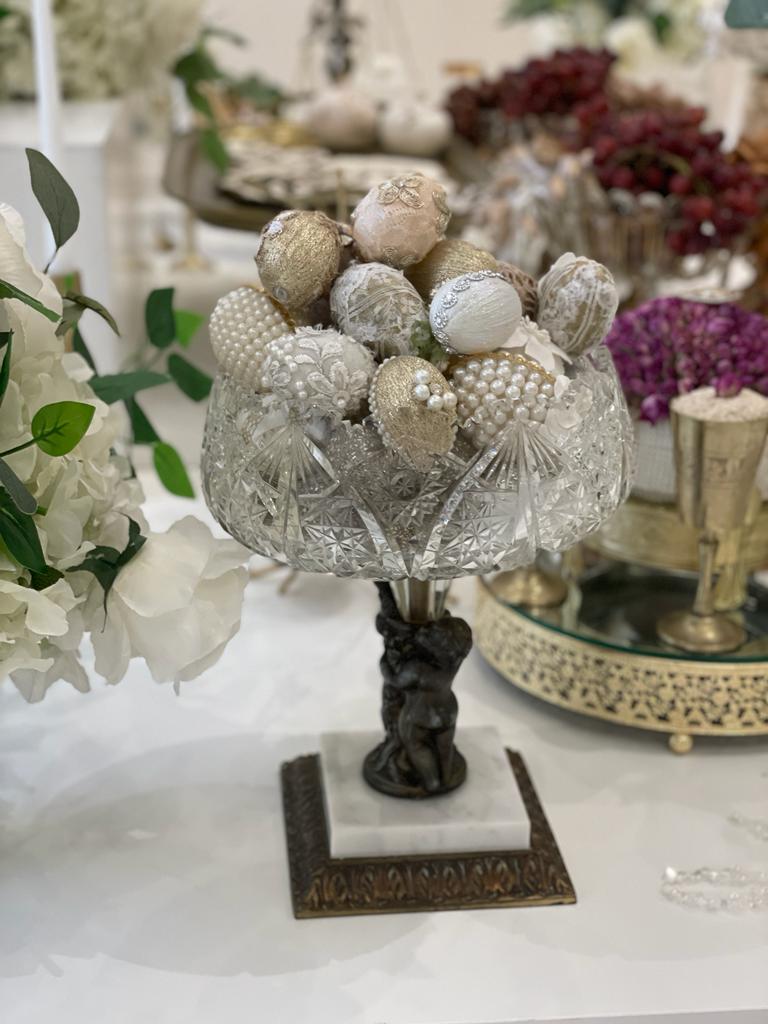
| Tokhme Morgh · Eggs | Whole eggs, frequently painted, jeweled, gilded or wrapped to match the design. | Fertility, creation and new life. |
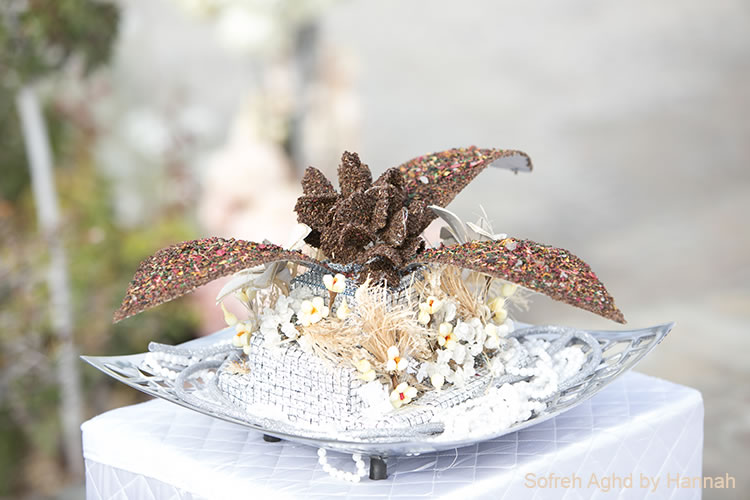
| Gerdoo, Badoom & other nuts | Walnuts, almonds, hazelnuts or other nuts, often still in their shells and elaborately decorated. | Fertility, abundance and a fruitful family life. Older regional explanations can be more specific. |
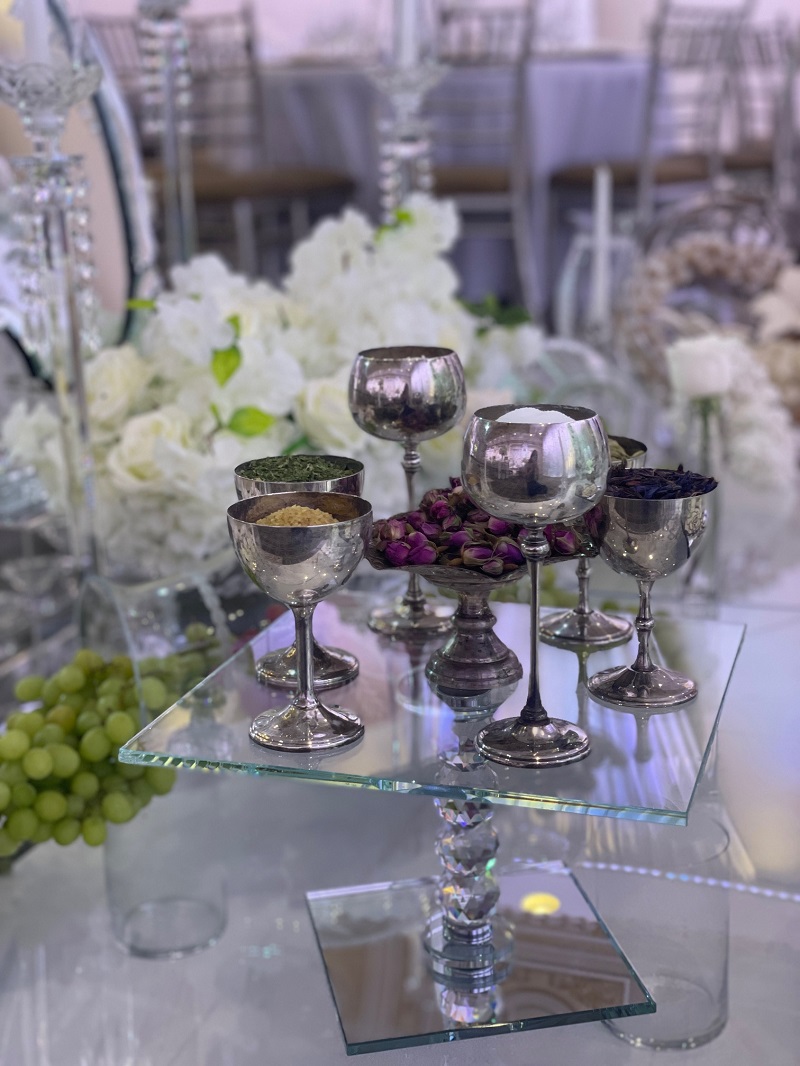
| Fruit | Apples, pomegranates, grapes and seasonal fruit are common. | Health, abundance, beauty and fruitfulness. Specific fruit symbolism varies by family and designer. |
| Sekkeh · Coins | Coins arranged loose, stacked or incorporated into decorative pieces. | Financial security, prosperity and abundance. |
| Asal · Honey | A small vessel of honey kept accessible for the end of the ceremony. | Sweetness in married life. The couple feeds honey to one another after consent or vows. |
| Kalleh Ghand · Sugar cones | Two hard sugar cones rubbed together above a cloth held over the seated couple. | A ritual wish that sweetness be showered onto the marriage. |
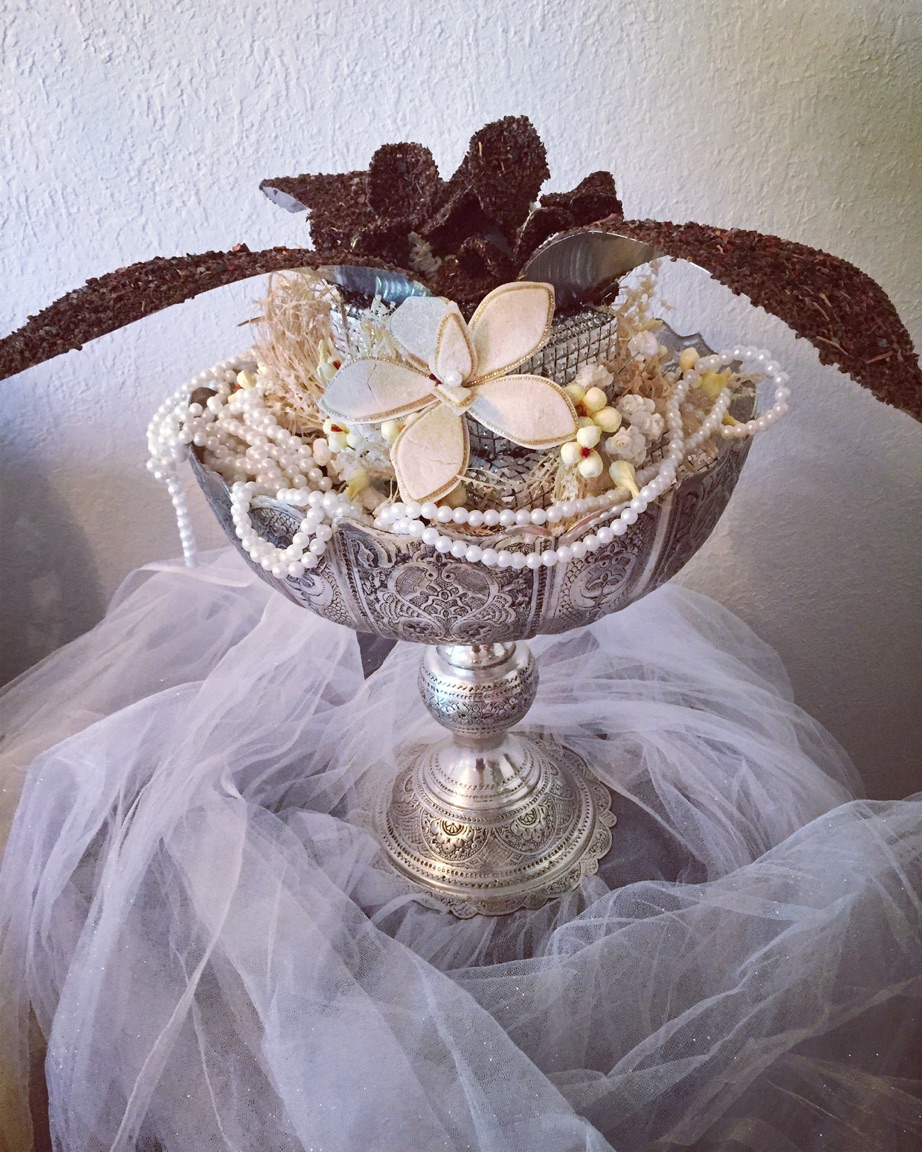
| Nabat · Crystallized sugar | Rock candy or crystallized sugar, often displayed in ornate bowls or sculptural arrangements. | Sweetness and joy. |
| Shirini / Noghl · Sweets | Persian pastries, sugared almonds or other sweets, commonly shared after the Aghd. | Celebration, sweetness and sharing good fortune with guests. |
| Esfand · Wild rue | Wild rue seeds displayed in a tray or burned as fragrant smoke. | Protection from the evil eye and negative energy; one of the oldest protective customs associated with the ceremony. |
| Herbs & spices | Small vessels of herbs, grains and spices; one well-known modern grouping is often called atel-o-batel. | Protection, health and prosperity. The exact list and explanations vary, so do not worry if your family uses a different combination. |
| Golab · Rosewater | Rosewater in a decorative bottle, sprinkler or bowl. | Fragrance, freshness, welcome and purity in common modern interpretations. |
| Flowers | Fresh florals woven throughout the Sofreh or surrounding it. | Beauty, growth and the freshness of a new beginning. Floral scale is largely a design choice rather than a fixed ritual rule. |
| Sabzi / greens | Fresh herbs or a bread-cheese-herb arrangement may appear on more traditional spreads. | Nourishment, freshness and prosperity; older regional customs attach additional meanings. |
| Sozan-o Nakh · Needle & thread | A needle and thread may be displayed or used symbolically while sugar is rubbed. | Often interpreted today as joining two lives or mending distance. Historical versions include playful in-law symbolism. |
| Termeh or family textile | An embroidered Persian textile, lace, silk or heirloom cloth beneath or within the Sofreh. | Continuity, family history and Persian craft. This is especially meaningful when the textile actually comes from the family. |
| Heirlooms & personal pieces | Jewelry, photographs, vessels, calligraphy, rings or inherited objects. | These are not mandatory “traditional items,” but they can make the Sofreh belong to a particular family rather than a rental catalog. |
Spellings vary in English because Persian words are transliterated in different ways: ayeneh/ayneh, kalleh ghand/kaleh ghand, sofreh/sofra, and aghd/aqd can all refer to the same terms.
Which Sofreh Aghd items are essential—and what can you skip?
Ask five Persian families for the “mandatory” list and you may get five slightly different answers. That is not a problem; it is evidence that the tradition has always been lived through families rather than enforced from one central rulebook.
Start here
Mirror, candles, a meaningful book, bread, sweetness, fertility/abundance items and the pieces needed for the actual ceremony—especially sugar cones and honey.
Add your family’s pieces
Esfand, coins, nuts, eggs, fruit, herbs, spices, rosewater, sweets, greens, decorated wheat and heirloom textiles are all familiar additions.
Make it yours
Family jewelry, photographs, calligraphy, custom trays, a parent’s wedding cloth, a favorite poet, modern sculpture or another cultural tradition can be added with intention.
A better question than “Is this item allowed?” is: does someone in the family know why it is here? A smaller Sofreh with twelve understood pieces usually feels more authentic than forty objects copied from Pinterest because they looked Persian.
If a ritual requires an object, keep it functional. Honey should be reachable. Sugar cones should not be glued permanently into a centerpiece. The book should be positioned where it can actually be read or touched if your ceremony uses it. Tradition works best when it is not trapped under décor.
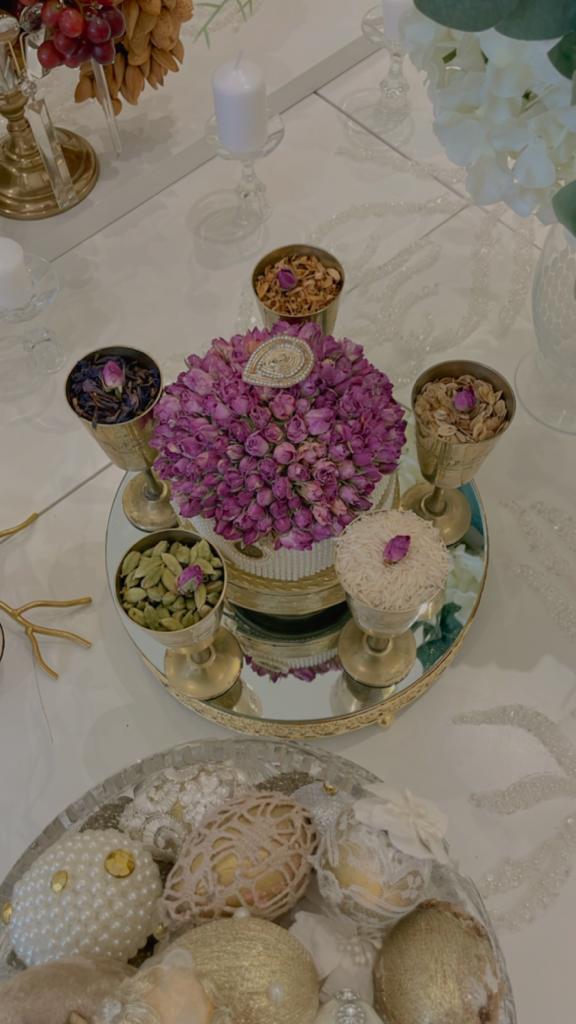
Traditional, modern or simple Sofreh Aghd: what actually changes?
The symbolism does not dictate the aesthetic. That is why two families can use almost the same core items and end up with Sofrehs that look nothing alike.
Modern does not mean “less Persian”
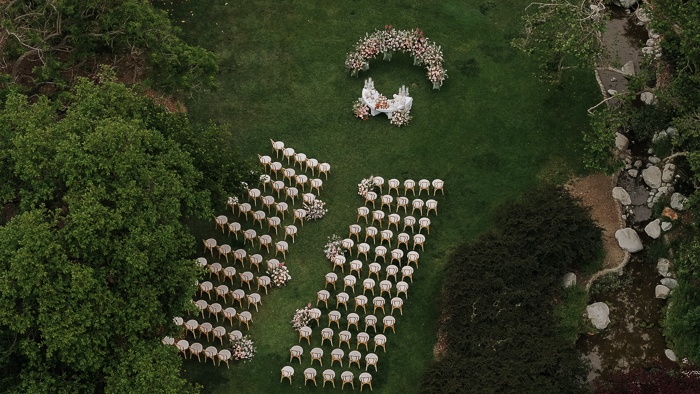
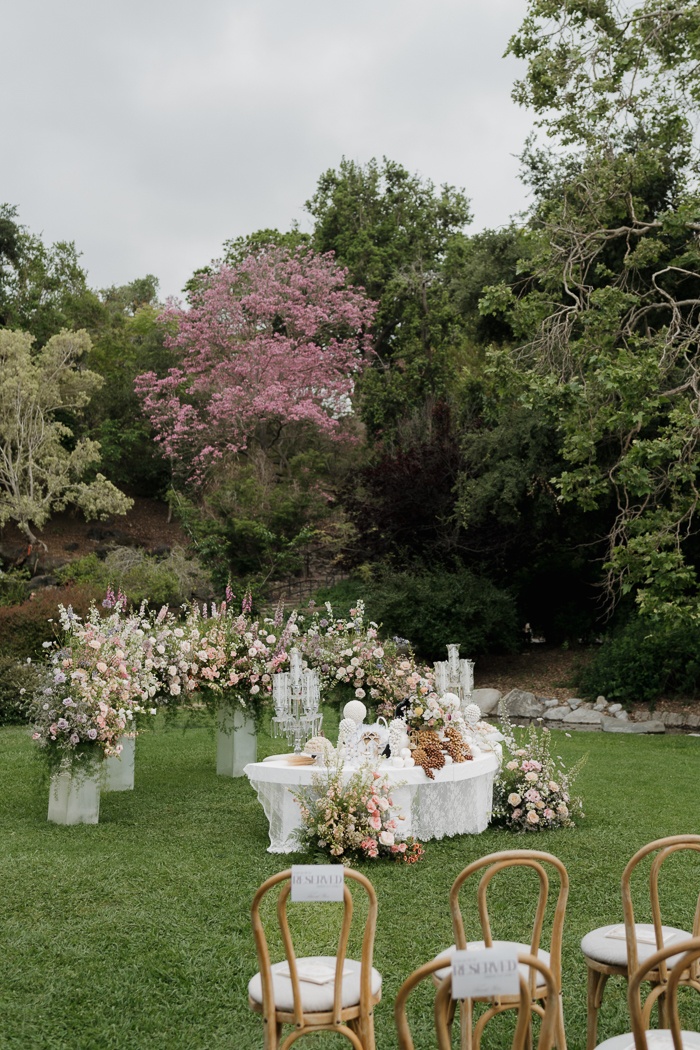
A raised white platform in a Napa vineyard can be every bit as recognizably Persian as a silver-and-termeh Sofreh in a ballroom. What matters is whether the cultural pieces are still legible and whether the rituals can still happen.
One of the strongest recent diaspora examples is the move away from assuming the Sofreh must be a long rectangular table. Couples have used round formats, curved forms and clusters of low plinths. That kind of change is successful when the redesign solves a real visual problem—better sightlines, a more intimate ceremony, stronger fit with the venue—rather than simply chasing novelty.
A simple Sofreh is harder than it looks
Minimalism removes places to hide. If you only use ten or twelve elements, every vessel, textile and proportion becomes visible. Choose a strong mirror, keep the heights balanced and let food and ceremonial pieces provide texture. You do not need to fill every inch with baby’s breath or crystal.
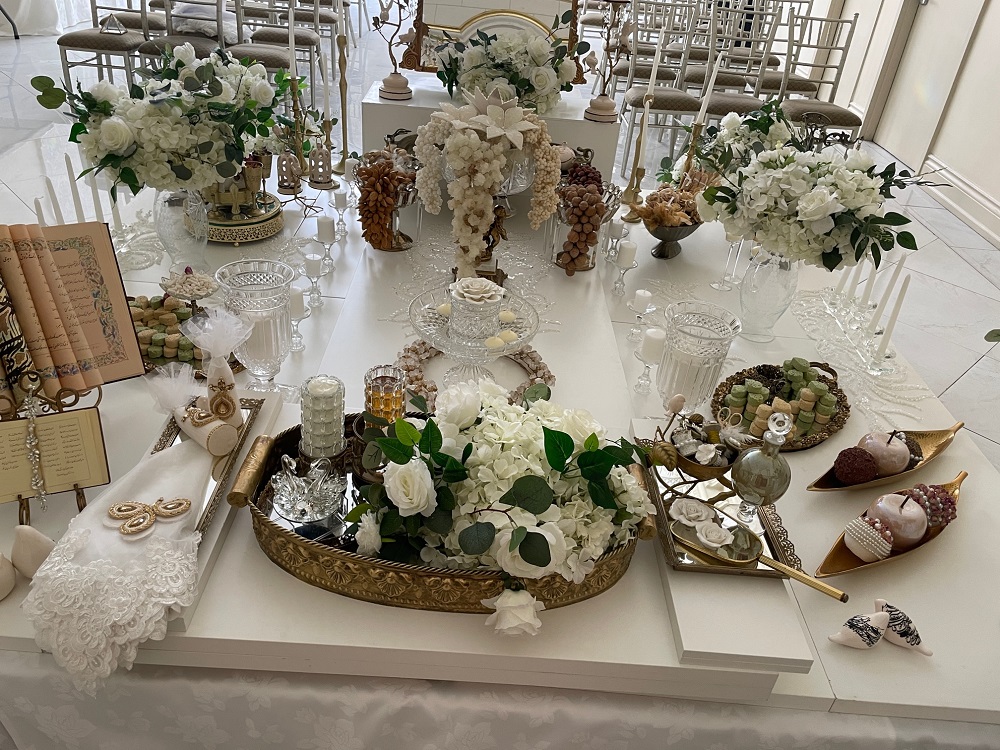
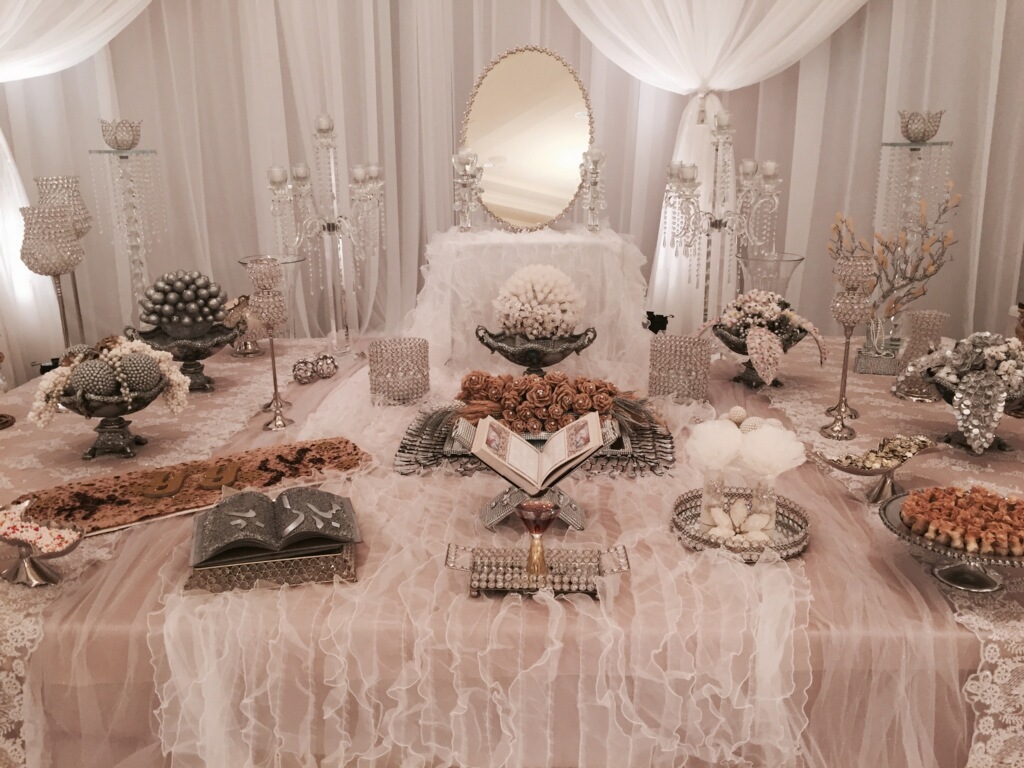
How to arrange a Sofreh Aghd so it looks good and still works
A designer can make the objects beautiful. A good Sofreh designer also understands where the couple sits, where the officiant stands, what relatives need to reach, and how the photographer will see the ceremony.
1. Build around the mirror
The mirror is usually the strongest central object. It should be large enough to register in photographs but not so tall that the couple disappears behind it. If the Sofreh is low, angle the mirror carefully so it reflects faces or architecture—not a ceiling vent.
2. Create height without building a wall
Candlesticks, floral pieces and risers give the spread depth. Keep the central sightline open. A gorgeous table that hides the bride and groom from half the guests is badly designed.
3. Separate ritual pieces from display pieces
Honey, rings, the marriage document and anything the officiant touches should be easy to reach. Sugar cones and the sugar cloth should be staged nearby. The person running the ceremony should know exactly where they are.
4. Use repetition instead of clutter
Three bowls of nuts at different heights, repeated crystal vessels, a sequence of candles or grouped fruits will usually look more intentional than twenty unrelated containers. Repetition is especially helpful when combining inherited pieces from different eras.
5. Photograph it before guests arrive
Ask the planner to give the photographer ten clean minutes with the finished Sofreh before guests sit down. Get a straight-on view, one angled view, the mirror and candles, bread, eggs/nuts, book, sugar, honey, esfand and any heirloom items. Once the ceremony begins, those unobstructed photographs are gone.
6. Test the sugar-cloth space
Family members need enough room to stand behind or beside the seated couple and hold the cloth without hitting the arch, candles or suspended flowers. This sounds obvious until a six-foot floral structure is installed exactly where four relatives are supposed to stand.
The diaspora Sofreh: Persian enough to feel like home, personal enough to feel like you
Persian weddings in Los Angeles, the Bay Area, Toronto, Vancouver, London and New York often have mixed guest lists. One partner may be Iranian and the other may not be. The couple may speak English more easily than Farsi. Their parents may be secular, Muslim, Jewish, Christian, Zoroastrian—or two different things in the same family.
The Sofreh handles that complexity unusually well because it is not dependent on one visual religious symbol. The book is the clearest example. Some families place the Quran; others use the Torah, Bible or Avesta; many modern couples choose Hafez, Rumi, the Shahnameh or another text that better reflects their home.
Mixed-culture couples can also let the Sofreh carry objects from both sides of the family. A Persian mirror can sit with a grandmother’s lace. An Iranian-American bride can use her mother’s sugar cloth while choosing modern vessels. A Persian-Jewish couple can place the Sofreh beneath a chuppah. The point is not to blend everything until no tradition is recognizable; it is to let meaningful traditions share the same space.
For non-Persian partners: you do not need to pretend every piece has been part of your life forever. Learn the objects you are using, ask your partner’s family what matters to them, and participate sincerely. That reads as respect much more clearly than memorizing a script.
For the broader sequence—where the sugar ritual, baleh, vows and honey happen—see our full Persian wedding ceremony guide. For how the Aghd fits into khastegari, bale boroon, the aroosi and the larger wedding, see Traditional Persian Wedding.
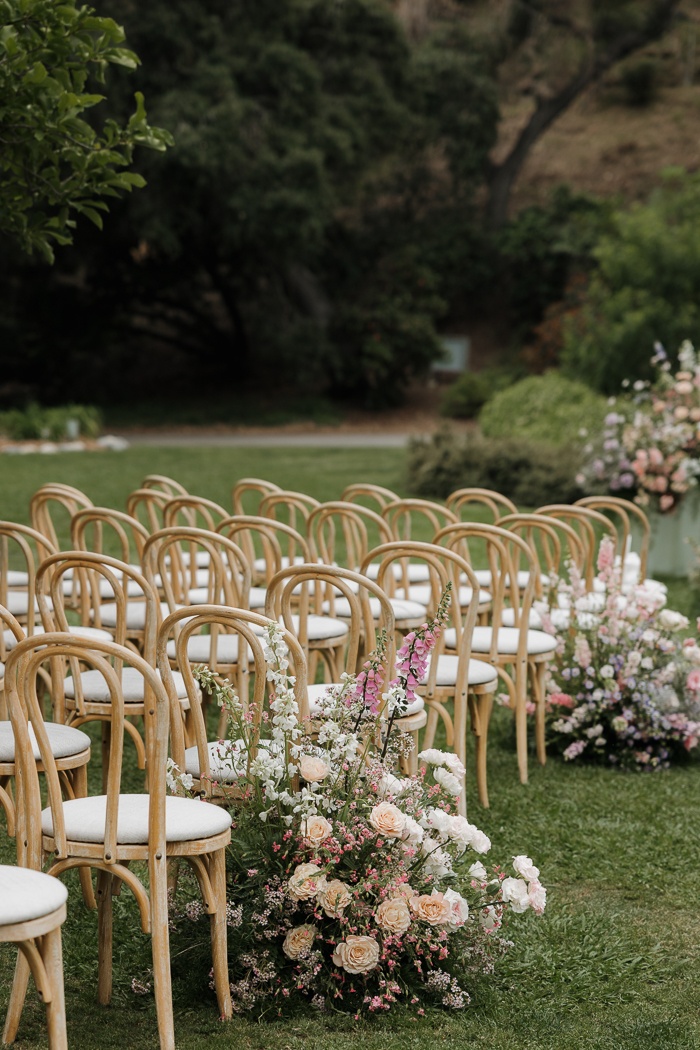
A practical Sofreh Aghd planning checklist
The Sofreh can become one of the most expensive and complicated ceremony elements if no one decides what matters early. Before paying for a custom installation, settle the cultural pieces first.
- Ask both families for their non-negotiables. Find out if there are objects, religious texts, heirloom cloths or regional customs they expect before the designer finalizes a concept.
- Decide floor-level vs. raised. Consider the couple’s outfits, mobility, venue rules, guest sightlines and how long they will sit during the Aghd.
- Choose the book intentionally. Do not default to a religious text simply because a rental company includes one. Use the text that actually represents the couple or family.
- Confirm who provides ritual items. Sofreh designers, planners, officiants and families often assume someone else is bringing the sugar cones, honey, sugar cloth or esfand.
- Keep food-safe pieces separate from craft pieces. If the couple will eat the honey or guests will share pastries, those items should be fresh and handled appropriately rather than treated as permanent props.
- Give the photographer an item list. Five minutes of preparation can prevent a family heirloom or meaningful book from being missed completely in the detail photos.
- Plan the teardown. Decide who takes the mirror, candlesticks, book, sugar cones and heirlooms at the end of the night. Do not let culturally meaningful objects disappear into a rental return.
Done well, a Persian wedding Sofreh is not just a beautiful table. It is one of the few parts of the wedding where food, family objects, poetry, superstition, craft, ritual and design all meet in the same place. That is why people remember it.
Sofreh Aghd FAQs
What is a Sofreh Aghd?
A Sofreh Aghd is the ceremonial spread arranged in front of a couple during the Persian Aghd wedding ceremony. It holds symbolic objects associated with light, sweetness, fertility, prosperity, protection, nourishment, wisdom and the couple’s future life together.
What does Sofreh Aghd mean in English?
Sofreh means a spread or cloth used for arranging food or ceremonial objects. Aghd refers to the marriage-contract ceremony. “Persian wedding table” is common English shorthand, but “ceremonial wedding spread” is closer to the original idea.
What items go on a Sofreh Aghd?
Common Sofreh Aghd items include a mirror, two candlesticks, a meaningful book, bread, eggs, nuts, fruit, coins, honey, sugar cones, crystallized sugar, sweets, esfand, herbs or spices, rosewater and flowers. Families may add textiles, jewelry, greens, wheat, needle and thread or other heirlooms.
What do the mirror and candles mean on a Persian wedding table?
The mirror is associated with brightness, clarity and the couple’s future reflected together. Candles are associated with light and brightness in married life. Historical descriptions also treat the paired candlesticks as representing the bride and groom.
What are the sugar cones on a Sofreh Aghd for?
The kalleh ghand are hard sugar cones used during the ceremony. Family or friends hold a fine cloth above the seated couple while sugar cones are rubbed together over it, symbolically showering the marriage with sweetness.
Does the Sofreh Aghd have to include a Quran?
No. The book reflects the family and couple. Some use the Quran, while Persian Jewish, Christian or Zoroastrian families may use their own religious texts. Secular couples commonly choose Persian poetry such as Hafez or Rumi, the Shahnameh or another meaningful book.
Can you have a modern or simple Sofreh Aghd?
Absolutely. A modern Sofreh may use clean lines, raised acrylic or mirrored platforms and restrained florals. A simple Sofreh can use fewer objects and still feel unmistakably Persian when the core symbolic and ritual pieces are present.
Is every Sofreh Aghd supposed to have the same items?
No. Historical sources themselves note regional variation, and contemporary families differ by religion, geography and personal tradition. There is a recognizable core, but no universal item list that every Persian family follows exactly.
Is a Sofreh Aghd the same as the Persian wedding ceremony?
No. The Aghd is the ceremony. The Sofreh Aghd is the ceremonial setting placed before the couple. Rituals such as the consent sequence, sugar rubbing and honey exchange happen during the Aghd around the Sofreh.